MAX THE CREATIVE 4TH Sponsor Interview – COVI Group
-a news story : https://www.mobiinside.co.kr/2023/08/01/max-the-creative-4th-covi/

Mobidays, a digital marketing company, recently hosted MAX THE CREATIVE 4th, an event designed to share creative strategies in a more focused and in-depth way.
Now in its fourth year, MAX THE CREATIVE is a flagship event where leading creative companies participate as speakers, sharing the latest trends and insights in the advertising industry.
Under the theme “Discover the Next Creative,” this year’s event highlighted the growing importance of creativity amid increasingly complex marketing methodologies. The sessions explored new business opportunities and creative strategies together with industry professionals and clients.
As one of the first offline events since the lifting of mask mandates, MAX THE CREATIVE 2023 provided a long-awaited opportunity for advertising professionals and experts to connect in person. With strong interest and support from various sponsoring companies, the event concluded successfully. In line with this, Mobinside is conducting a relay series of sponsor interviews for MAX THE CREATIVE 2023.
As the first interview in the series, we met COVI Group, the company behind the mobile video advertising media platform COVI. As both a sponsor and speaker at the event, COVI Group shared in-depth insights into the digital advertising industry, its core business, and its long-term vision.

Q. Hello, could you please introduce COVI Group and its core business?
Hello, nice to meet you. My name is Myungjin Park, CEO of COVI Group.
COVI Group is a video advertising technology startup founded in February 2018. In May 2019, we launched COVI, our mobile video advertising platform, and have continued to grow steadily ever since.
COVI is a mobile video advertising media platform that enables brands to reach mobile app and web users in the safest and most effective way. Through partnerships with over 70 media platforms and more than 200 advertising placements, COVI delivers video ads to approximately 30 million mobile app and web users per month.
Over the past five years, COVI Group has focused on the video advertising sector, continuously enhancing the platform and expanding its business. As a result of these efforts, we were selected for the TIPS (Tech Incubator Program for Startup) initiative by the Ministry of SMEs and Startups last year, receiving recognition for both our technological differentiation and business potential.


Q. You showed strong interest in participating in this year’s MAX THE CREATIVE offline event. How was your experience?
It was a great opportunity to introduce our platform and engage in meaningful conversations with agency professionals from a wide range of industries who attended the event.
Additionally, following our participation in MAX THE CREATIVE, we received partnership and advertising inquiries, which positively contributed to both COVI’s business opportunities and overall brand awareness.
Q. You participated as both a sponsor and a speaker. For readers who were unable to attend the event, could you briefly introduce the key topics covered in your session?
COVI Group has continuously explored various approaches within the video advertising market as it has evolved across different eras—from TV to PC and now to mobile. One question that has remained constant throughout these changes is which video advertising objectives and media mix are most effective in achieving a brand’s ultimate marketing goal: driving sales.
In each era, media selection for video advertising has been guided by different quantitative data standards—Reach and Frequency in the TV era, Impressions and Clicks in the PC era, and Targeting and Measurement in the mobile era.
With digital transformation, the video advertising market has also evolved from one-way ad viewing in the TV era, to interactive yet forced ad exposure on PCs, to skippable ads on mobile devices, and is now moving toward the next stage: voluntary ad engagement.

Q. Then, what criteria should we consider when selecting video advertising media today and in the future?
First, it is essential to take an integrated approach to all quantitative, data-driven criteria that have emerged across different eras of media evolution. At COVI, we support and propose optimized media operations based on key quantitative metrics—Reach, Frequency, Impressions, Clicks, Targeting, and Measurement—tailored to each brand’s objectives.
Second, we must go beyond quantitative data and begin to seriously evaluate qualitative criteria. In an era flooded with complex, uncontrolled, and unrefined content, media strategies driven solely by quantitative metrics are no longer sufficient. This is the time to incorporate qualitative validation into media decision-making.
To address this need, new standards such as Brand Safety and Viewability are becoming increasingly important. COVI provides a media environment where brands can secure advertising visibility in the safest possible way.
Q. Brand safety has recently become a key topic in the digital advertising industry, and COVI also emphasized it in your session. Could you explain how COVI ensures brand safety?
Brand safety was once considered a qualitative metric that was difficult to measure and often overlooked. Today, however, many global brands place strong emphasis on qualitative exposure standards alongside quantitative reach, using them as critical criteria for media selection.
Third-party media verification and measurement platforms such as IAS and DoubleVerify have long provided data and services aligned with global standards established by organizations like the IAB and MRC, enabling brands to evaluate and manage brand safety more effectively.

To ensure brand safety, COVI has established its own ad exposure guidelines and conducts a quarterly, full-scale review of all partner placements based on five specific evaluation criteria. These include brand safety, non-disruptive content consumption, and video playback only when 100% of the ad is visible within the mobile screen, among others.
As of Q2 2023, 96.5% of COVI’s partner placements met all evaluation criteria. In addition, recent testing conducted with a global third-party verification platform confirmed that 92.9% of COVI’s ad traffic was delivered on brand-safe placements.
Furthermore, COVI applies highly stringent viewability standards by automatically stopping ad playback when 100% of the ad placement is not visible or when the placement leaves the user’s viewport due to scrolling. This approach is significantly stricter than the global standard of 50% viewability.
To maintain a high qualitative standard for video ad exposure—including both brand safety and viewability—COVI continuously researches global benchmarks and reflects them through ongoing product development and policy implementation.

Q. What do you consider to be COVI’s key strengths that differentiate it from other companies in the field?
Low-quality ads that are indiscriminately exposed, as well as ads that force users to watch, often damage the user experience. This, in turn, leads to declining ad revenue for media partners and reduced brand advertising effectiveness.
To address these challenges, COVI strives to deliver a video advertising service that satisfies all stakeholders—viewers, brand advertisers, and media partners alike. One of COVI’s core differentiating technologies is its Native UX/UI Matching technology.
Native UX/UI Matching technology analyzes native elements of each partner media’s content—such as size, titles, colors, fonts, copy, and placement—and aligns COVI’s ad components to blend as seamlessly as possible with the surrounding content.
Through this technology, COVI is able to adapt video ads to the diverse native UX/UI environments of more than 200 different ad placements, allowing video advertisements to appear as a natural part of the content experience.

COVI provides a service that goes beyond forced viewing or skip-based advertising models. Instead, it identifies users who are most aligned with each video campaign’s objectives and creates opportunities for ads to be encountered naturally, enabling users to voluntarily watch video ads to completion.
In practice, this voluntary viewing model delivers significantly stronger performance. Compared to traditional video ads that interrupt content consumption, COVI campaigns achieve 1.5x to up to 10x higher full video completion rates (100% view-through rate).
In particular, analysis of various cases over the past four years shows that high-quality brand video creatives and longer-form video ads deliver more than twice the completion rate compared to other video media platforms.
COVI reaches approximately 30 million monthly unique users (UVs)—a user base closely aligned with the overall age and gender distribution of mobile users in Korea. Video ads are independently delivered across more than 200 diverse placements, including news and broadcast media, magazines, membership services, lock-screen platforms, and category-specific apps.
As a result, COVI media mixes enable advertisers to reach users of new mobile services that platforms like YouTube or traditional media often fail to cover. Through precise targeting optimization, brands can execute campaigns more effectively and efficiently.
Q. One of COVI’s key strengths is its advanced targeting optimization. Could you explain how this works?
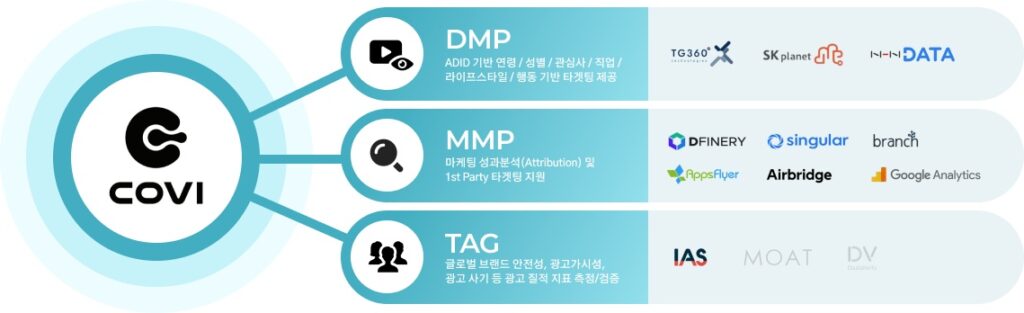
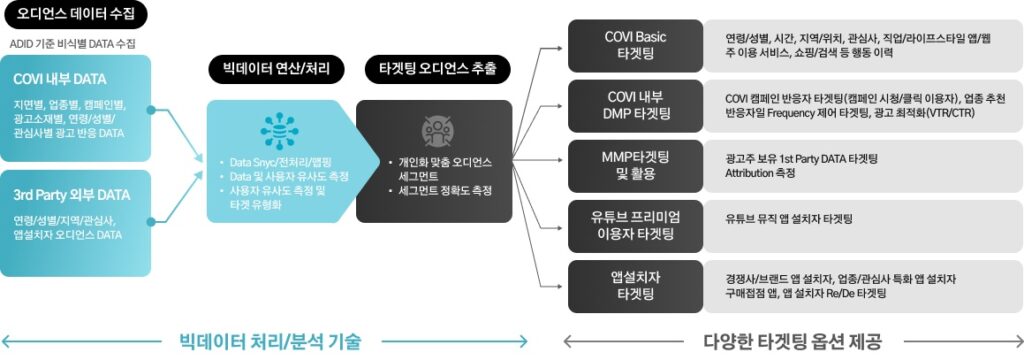
COVI is designed to integrate and analyze a wide range of data sources, including partner data, external DMP data such as SKP/TG360, third-party MMP data, and COVI’s own internal campaign performance data. This allows us to provide a variety of targeting scenarios tailored to advertisers’ campaign objectives.
Targeting options include age and gender, OS, interests, frequency controls, and retargeting (RE) / de-targeting (DE).
For example, depending on campaign goals, advertisers can combine app installation data, in-app behavior, interest data, and COVI’s industry-specific ad responder data to reach users whose profiles most closely match their brand’s customer persona. This approach significantly improves both view-through rates and click-through rates.
In addition, brands with strong first-party data have leveraged COVI’s retargeting capabilities to achieve more than twice the viewing and conversion efficiency compared to standard campaigns.
Q. Among recent COVI campaign cases, which ones stood out to you, and what insights can you share?
One notable example involves a global brand (Company A), which has consistently run video advertising campaigns across its entire product lineup through COVI over the past four years. Depending on campaign objectives, the brand utilized a wide range of creative formats, including vertical videos and durations of 5, 7, 15, 30 seconds, as well as long-form videos ranging from 1 to 9 minutes.
The brand cited three main reasons for continuing long-term campaigns with COVI:
flexibility in creative asset operations,
a high likelihood of meeting brand safety and viewability standards compared to other domestic media, and
significantly higher video completion rates, which improved overall media mix efficiency.
Another impactful case involved a leading domestic financial services company (Company S). During the launch of a new financial product, the company ran COVI campaigns targeting users in their 20s and 30s with two objectives: brand awareness through video advertising and subscriber acquisition.
Through pre-campaign targeting optimization, extraction of prior COVI responder segments, and optimized placement operations, the campaign achieved 10x higher CTR than general campaigns and reached its conversion goals ahead of schedule within six months.
Both cases are meaningful examples of how COVI delivers not only high video completion rates but also strong purchase and conversion performance through video advertising.
In addition, content-driven advertising formats—such as movie promotions, OTT content, public campaigns, and branded content—blend naturally into COVI’s content placements. These campaigns consistently demonstrate higher effectiveness than traditional ads and often lead to continued rebooking on the COVI platform.
Q. Finally, could you share COVI’s goals for the second half of the year and its long-term vision?
Moving forward, we will continue to address the fundamental challenges of the traditional video advertising market and enhance COVI into an AI-powered integrated video advertising platform that delivers better advertising experiences for viewers, media partners, and advertisers alike.
Our focus areas include the development of UX/UI automation technologies, personalized ad recommendations based on integrated data, advanced ad performance analysis, prediction, and modeling, and the enhancement of video ad creatives. By continuously developing and commercializing innovative video advertising technologies that meet customer needs, we aim to build globally competitive capabilities and drive sustainable growth.
Sources : https://www.mobiinside.co.kr/2023/08/01/max-the-creative-4th-covi/